

What is short-termism? Definition and meaning
Short-termism is what people suffer from if they focus excessively on
short-term results at the expense of an individual’s, company’s, or
country’s long-term interests. People who are doing things that make
themselves better off in the short-run but worse off in the end are
guilty of short-termism.
Following the stock market bubble burst and the failure of Enron at the beginning of this century, accusations of short-termism were made against American and British stock market-focused capitalism.
Investors had become obsessed with short-term profits and share-price fluctuations, and failed to check out companies’ long-term performances, it was claimed.
This short-term approach by investors influenced company’s senior managers, who tried to make business profits look as good as possible over the short term, often at the expense of the commercial enterprise’s long-term health.
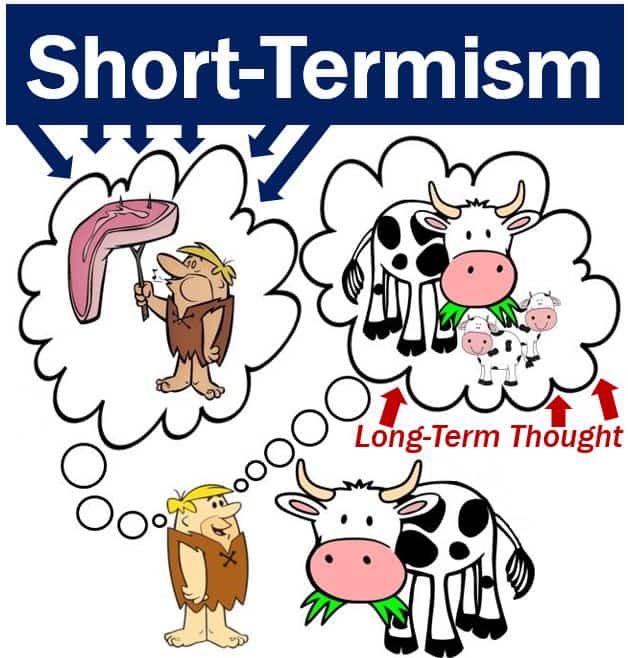 In
this image, Barney, Fred Flinstone’s best friend, has two thoughts
while looking at his cow. He could slaughter it and enjoy the benefits
now, or wait until the cow reproduces. Eating the steak is an example of
short-termism – if he eats the meat now, he will not have anything in
the long-term future.
According to the Oxford Living Dictionaries, short-termism is the:
In
this image, Barney, Fred Flinstone’s best friend, has two thoughts
while looking at his cow. He could slaughter it and enjoy the benefits
now, or wait until the cow reproduces. Eating the steak is an example of
short-termism – if he eats the meat now, he will not have anything in
the long-term future.
According to the Oxford Living Dictionaries, short-termism is the:
“Concentration on short-term projects or objectives for immediate profit at the expense of long-term security.”
The dictionary offers the following phrase as an example of the term used in context: “When the goal is to make quick gains, then the means to achieve them may be nothing more than short-termism.”
Mr. Donaldson further encouraged senior management to present to investors exactly how they had planned to manage the business.
At a 2005 CFA Institute annual conference, Mr. Donaldson said that ‘short-termism’ was a top critical issue that the financial industry was facing.
Following the stock market bubble burst and the failure of Enron at the beginning of this century, accusations of short-termism were made against American and British stock market-focused capitalism.
Investors had become obsessed with short-term profits and share-price fluctuations, and failed to check out companies’ long-term performances, it was claimed.
This short-term approach by investors influenced company’s senior managers, who tried to make business profits look as good as possible over the short term, often at the expense of the commercial enterprise’s long-term health.
In
this image, Barney, Fred Flinstone’s best friend, has two thoughts
while looking at his cow. He could slaughter it and enjoy the benefits
now, or wait until the cow reproduces. Eating the steak is an example of
short-termism – if he eats the meat now, he will not have anything in
the long-term future.“Concentration on short-term projects or objectives for immediate profit at the expense of long-term security.”
The dictionary offers the following phrase as an example of the term used in context: “When the goal is to make quick gains, then the means to achieve them may be nothing more than short-termism.”
2006 Short-termism report
Former US Securities & Exchange Commission (SEC) Chairman, William H. Donaldson, called upon business leaders in a 2003 corporate governance forum to “[to] manage the business for long-term results and to get away from the attitude that you are managing the business out of a straight jacket that has been put upon you to create earnings-per-share on a regular basis.”Mr. Donaldson further encouraged senior management to present to investors exactly how they had planned to manage the business.
At a 2005 CFA Institute annual conference, Mr. Donaldson said that ‘short-termism’ was a top critical issue that the financial industry was facing.
